
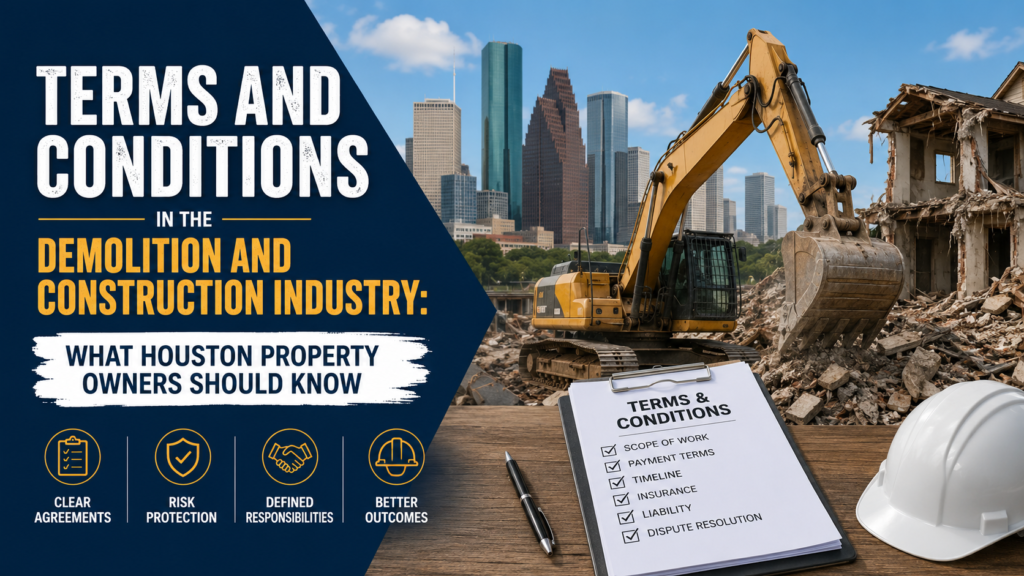
When you engage a construction or demolition contractor in Houston for a project whether it is a residential teardown, a commercial renovation, site grading, or debris removal the relationship is governed by a set of Terms and Conditions of Vm Demolition Houston that define the rights and obligations of both parties. Terms and conditions (sometimes presented as service agreements, contractor agreements, or general conditions of contract) are the legal framework within which the work is performed, and understanding their key provisions helps Houston property owners enter into these relationships with clear expectations and appropriate protection.
What Terms and Conditions Are
Terms and conditions are contractual provisions that establish the rules governing the business relationship between a service provider and its customer. For demolition and construction companies in Houston, these terms typically cover the scope of services, payment obligations, liability limitations, warranty provisions, cancellation policies, and dispute resolution procedures. They may be presented as a separate document, as part of a formal contract, or as website terms that govern online service interactions.
In Texas, construction contracts are governed by a combination of general contract law principles and specific statutes including the Texas Property Code (which contains contractor protections and disclosure requirements), Texas Occupations Code (governing contractor licensing), and various other statutes applicable to specific service types. Understanding the legal context helps property owners evaluate whether the terms being offered are standard and reasonable.
Scope of Services and Change Orders
One of the most important provisions in any demolition or construction terms and conditions is the definition of the scope of services. The scope should clearly specify:
- What work is included: The specific demolition, grading, clearing, or debris removal activities that the contractor will perform.
- What work is excluded: Items that are specifically outside the contractor’s scope, which the property owner must either perform themselves or engage additional contractors for.
- Site conditions and assumptions: Any conditions assumed in the proposal (such as the absence of regulated hazardous materials, accessible site entry, or specific utility disconnection status) that, if not accurate, may affect the scope.
Change orders modifications to the original scope that arise during the project should be addressed in the terms. Standard practice is for changes to be documented in writing, signed by both parties, and include any adjustment to the project price and schedule before work on the changed scope begins. Property owners should be cautious about contractors who verbally agree to changes without documenting them.
Payment Terms in Houston Construction Projects
Texas construction law gives contractors specific protections regarding payment, and terms and conditions typically reflect these legal protections:
- Contractor lien rights: Texas Property Code Chapter 53 gives construction contractors the right to file a mechanic’s lien against a property for unpaid work. Property owners who fail to pay according to the contract terms risk having a lien placed on their property. Understanding this before signing a contract is important.
- Notice requirements: Texas Property Code imposes specific notice requirements on contractors and subcontractors to preserve lien rights. Many contractor terms include provisions about these notices.
- Payment schedule: Terms typically specify when payments are due commonly a deposit at contract signing, progress payments at defined milestones, and a final payment upon completion. Understanding these payment milestones helps property owners plan for cash flow.
- Retainage: On larger commercial projects, it is common practice to retain a percentage of each progress payment (typically 10 percent) until the project is substantially complete. Texas Property Code governs retainage on certain project types.
Liability, Insurance, and Indemnification
Demolition and construction work involves inherent risks, and terms and conditions address how liability for accidents, damages, and other adverse events is allocated between the contractor and the property owner:
- Contractor insurance requirements: Reputable demolition and construction contractors in Houston carry general liability insurance, workers’ compensation insurance (required by Texas law for most contractors with employees), and automobile liability insurance. Terms may specify the contractor’s insurance obligations and provide for the property owner to be named as an additional insured.
- Limitation of liability: Many contractor terms include provisions limiting the contractor’s maximum liability for damages to the amount paid under the contract or to specific categories of damages.
- Indemnification: Terms typically specify that the property owner will indemnify the contractor against claims arising from property owner negligence or misrepresentation, and vice versa.
- Hazardous materials: Terms often contain specific provisions about how undiscovered hazardous materials (asbestos, lead, petroleum contamination) discovered during work are handled typically providing for a work stoppage, property owner notification, and adjustment of scope and price to address the condition.
Dispute Resolution
When disagreements arise between property owners and contractors over the quality of work, the scope completed, or payment, the terms and conditions typically specify how those disputes should be resolved. Common dispute resolution provisions in Houston construction contracts include:
- Mediation: A non-binding process in which a neutral third party facilitates discussion between the parties to reach a mutually acceptable resolution.
- Arbitration: A binding process in which a neutral arbitrator hears both sides and issues a decision. Many construction contracts require disputes to go to arbitration rather than litigation.
- Litigation and venue: If the contract allows for court proceedings, terms typically specify that litigation must occur in Harris County, Texas.
Conclusion
Terms and conditions for demolition and construction services in Houston are not bureaucratic fine print they are the legal framework that defines what you are getting, what you are paying, what happens if something goes wrong, and what your rights are throughout the project. Houston property owners who take the time to read and understand contractor terms before signing are better positioned to manage the project effectively, avoid misunderstandings, and protect their interests if disputes arise. When in doubt about specific provisions, consulting with a Texas attorney familiar with construction law before committing to significant demolition or construction work is a wise investment.