Queue Management System in Saudi Arabia: The 2026 Playbook for Faster Service
A modern queue management system in Saudi Arabia is no longer a nice-to-have for banks, clinics, and government service centers — it is the backbone of a calm, measurable customer journey. As the Kingdom accelerates its Vision 2030 digital agenda, organizations in Riyadh, Jeddah, and Dammam are replacing paper tickets and tangled lines with smart, data-driven flow management. This 2026 guide explains how these systems work, what they cost in real terms, and how to roll one out without disrupting daily operations.
We have deployed and audited dozens of these setups across retail counters and public-sector branches, so the advice below is grounded in what actually moves the needle on wait times.
Why a queue management system in Saudi Arabia matters in 2026
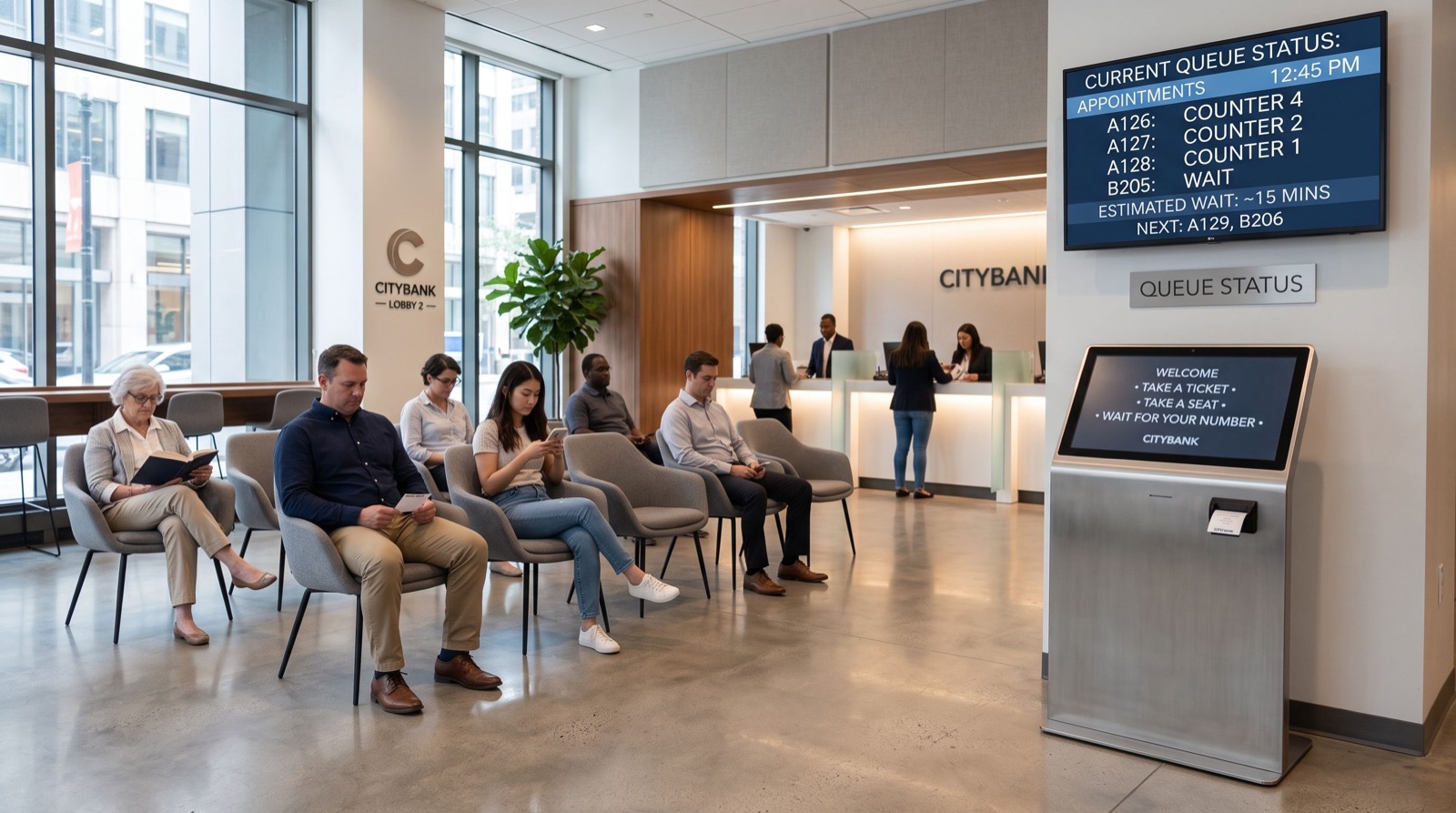
Saudi consumers expect service that feels effortless. When a visitor walks in, the system assigns a ticket by phone, kiosk, or QR code, routes them to the right counter, and keeps them informed on a digital display. The result is shorter perceived waits, fairer service order, and happier staff.
The national push toward paperless government, outlined by the Saudi Vision 2030 program, has made digital flow control a default expectation rather than a luxury. Branches that still rely on first-come chaos lose customers to competitors who measure and optimize every minute.
The core benefits
- Shorter wait times: intelligent routing cuts idle counters and bottlenecks.
- Real-time data: managers see live load and reassign staff instantly.
- Fairness: digital tickets end disputes over who was first.
- Arabic-English support: bilingual displays and announcements suit every visitor.
- Integration: link to CRM, appointment booking, and access control.
Organizations that want a proven, locally supported platform often start with a dedicated queue management system in saudi arabia built for high-volume branches. Choosing a solution designed for the Kingdom’s bilingual, high-footfall environment avoids the costly rework that comes from forcing a generic foreign product to fit local service rules.
Consider a typical Riyadh bank lobby on salary day. Without digital flow control, the floor manager spends the morning firefighting — physically walking the line, apologizing, and guessing which counter to open next. With a smart queue in place, the same manager watches a live dashboard, opens an extra teller the moment load climbs, and keeps the whole branch calm. That shift from reactive to proactive management is the real transformation.
How the technology works end to end
At its heart, the platform coordinates three layers: a ticketing front end, a routing engine, and a reporting dashboard. A customer takes a ticket, the engine predicts the fastest route based on live counter status, and the dashboard records every touchpoint for later analysis.
Many Saudi branches now pair the flow system with identity and attendance hardware. A fingerprint-based Biometric Device at the staff entrance confirms who is actually on the counter, so supervisors can match service speed to real staffing — not the roster on paper. That link between people data and queue data is where the biggest efficiency gains hide.
For organizations comparing vendors, it pays to work with dependable specialists who can integrate the hardware, software, and reporting into one maintainable stack rather than stitching together mismatched parts.
Deployment steps that keep service running
- Map every service type and its average handling time.
- Pilot one busy branch for two weeks and capture a baseline.
- Install kiosks, displays, and the staff biometric terminal.
- Train agents on the dashboard and escalation rules.
- Review live reports weekly and tune routing rules.
Choosing the right queue management system in Saudi Arabia
Not every branch needs the same configuration. A high-traffic bank lobby has very different demands from a small clinic. Use the table below to match your environment to the features that deliver the strongest return.
| Environment | Daily visitors | Must-have features | Nice to have |
|---|---|---|---|
| Bank branch | 300–800 | Multi-counter routing, CRM link, SMS alerts | Appointment pre-booking |
| Government service center | 500–1,500 | Bilingual displays, priority lanes, analytics | Satisfaction survey kiosk |
| Clinic or hospital | 150–600 | Department routing, call-forward, privacy | Doctor availability feed |
| Retail or telecom store | 100–400 | Mobile ticketing, product-expert routing | Loyalty integration |
Questions to ask every vendor
- Does the platform support full Arabic and English interfaces?
- Can it integrate with our existing CRM and access control?
- What local support and warranty terms apply in the Kingdom?
- How granular is the reporting — per agent, per service, per hour?
Measuring return on investment
Return shows up fast when you track the right numbers. Branches we have reviewed typically cut average wait times by 30–45% within the first quarter after a proper rollout. The hidden win is staff efficiency: when supervisors see live queue load next to verified attendance, they redeploy people before a line forms rather than after.
Government bodies can benchmark their service targets against the standards published on the Saudi national digital services portal, which sets clear expectations for responsive, citizen-first service. Aligning your internal KPIs to those public benchmarks keeps your branch audit-ready.
One practical tip from the field: do not chase a perfect average. Watch the 90th-percentile wait instead. That is the number that frustrated customers actually feel, and squeezing it down does more for your reputation than shaving a few seconds off the mean.
Common mistakes to avoid
Even good platforms get undermined by avoidable errors. The most frequent is skipping the baseline measurement, which leaves you unable to prove any improvement later. Another is over-configuring routing rules on day one; start simple and add complexity only when the data demands it.
Teams also forget change management. Front-line staff need to understand why the system exists, or they quietly route around it. A short training session and a clear escalation path prevent that. Finally, do not treat reporting as a launch-week novelty — the dashboard earns its keep only when someone reviews it every week and acts on what it shows.
Frequently Asked Questions
How much does a queue management system in Saudi Arabia cost?
Entry setups for a single branch start modestly, while multi-counter deployments with kiosks, displays, and biometric integration scale with hardware and licensing. Request a per-branch quote based on your daily visitor volume rather than a flat package price.
Can the system work in both Arabic and English?
Yes. Any serious platform sold in the Kingdom ships with full bilingual ticketing, displays, and voice announcements so every visitor is served clearly in their preferred language.
How long does implementation take?
A single-branch pilot usually goes live within two to three weeks, including a baseline measurement period. A multi-branch rollout is phased over one to three months depending on network readiness and staff training.
Does it integrate with biometric attendance hardware?
It can. Linking verified staff attendance to live queue load lets supervisors match counter staffing to demand in real time, which is one of the fastest ways to reduce waits.
Conclusion
In 2026, a well-chosen queue management system in Saudi Arabia turns a chaotic lobby into a measurable, improvable process. Start with one busy branch, measure honestly, integrate your people and flow data, and scale what works. Partner with experienced specialists, insist on bilingual support and clean reporting, and your wait times — and your customer satisfaction scores — will reward the effort. Ready to begin? Map your busiest branch this week and request a tailored demo.